
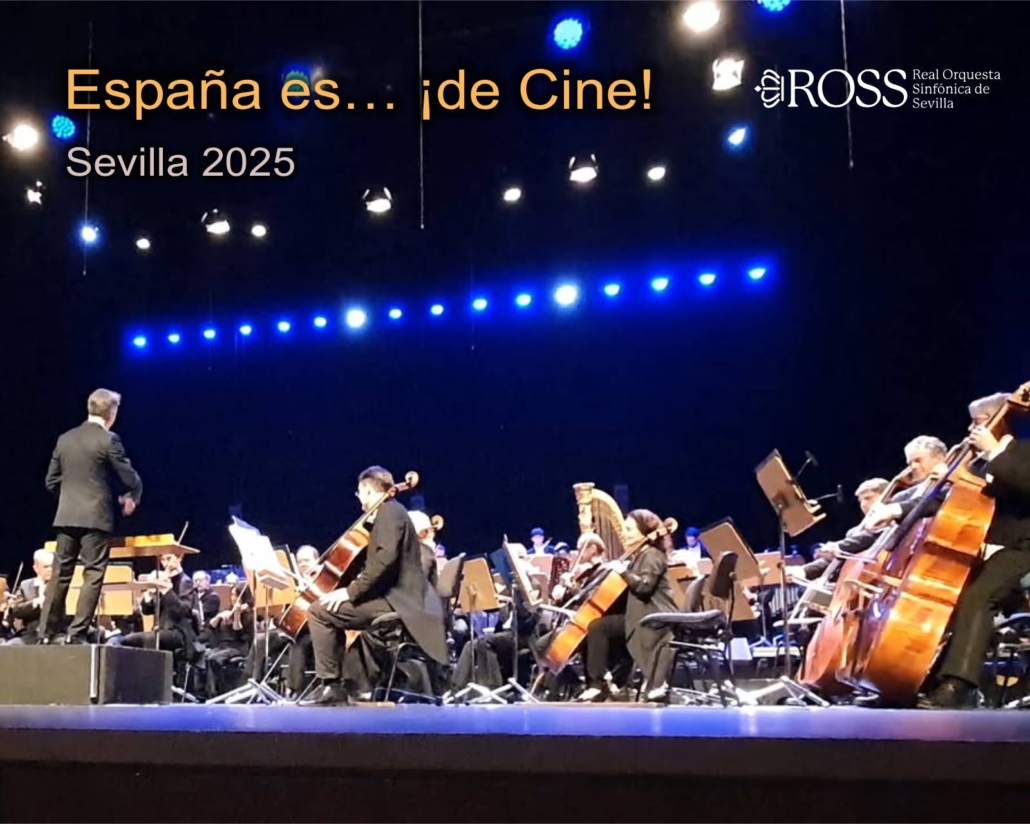
‘Spain is … Cinema!’ concert with the ROSS in Seville [SPECIAL ARTICLE]
In November 2025, the Real Orquesta Sinfónica de Sevilla – ROSS offered two performances of the concert “España es… ¡de Cine! / Spain is … Cinema!”. The first was on Friday, 14/11, at the Gran Teatro Falla in Cádiz as part of the ‘Andalucía Sinfónica. Festival de Música Española de Cádiz’ (Andalusia Symphony. Cádiz Spanish Music Festival) series, and the second on Saturday, 15/11, at the Cartuja Center Cite in Seville as the closing event of the ‘XXII Festival De Cine Europeo de Sevilla’ (22nd Seville European Film Festival) (read more).
Our colleague and friend Jose Carlos Fernandez Moscoso attended the concert and leaves us a great detailed summary exclusively for SoundTrackFest, including also a video of the full concert.

SPAIN IS... CINEMA (MUSIC)!
The ROSS gave a closing concert at the Seville European Film Festival, serving as an example to highlight the extraordinary film music that has been produced in Spain since the days of renowned Hollywood classical symphonies.
The Real Orquesta Sinfónica de Sevilla – ROSS / Royal Symphony Orchestra of Seville continues to prove itself as a reference in Spain for the performance of film soundtracks. This is corroborated by two factors: its firm commitment to including film music concerts in each annual program and its virtuoso execution of repertoires that also include works of diverse styles, as was the case with the concert “España es… ¡de Cine! / Spain is … Cinema!”., which was held at the Cartuja Center Cite on November 15, 2025, and whose title was justified by a compendium of soundtracks from Spanish-produced films and composers from our country.
The ROSS thus joined in the celebrations for the 22nd edition of the Seville European Film Festival, which had been running since November 7 and whose closing event, held in parallel with the film screenings, featured music as the main attraction this year. It seems that the orchestra’s board of directors and musicians took this initiative much more seriously than the festival organizers themselves, because on the evening of the event, the musical performance did not seem to have any connection with SEFF. There was no marketing or signage at Fibes, not even in the concert hall, and not a single festival director or representative saying a few words at the beginning to welcome the audience or even to justify the musical event and “sell” it to an audience that felt the coldness of the beginning of a show that was fortunately saved—which is what matters—by the virtuosity of the musicians conducted for the occasion by maestro Lucas Macías.

Virtuosity, diversity, and versatility, because the concert generated a mixture of nostalgia and contemporaneity in the audience thanks to the inclusion of classic works from both film and television, which have rarely been performed live by orchestras in recent decades, as well as soundtracks from current films by some of the most interesting composers on the national scene. From García Abril and Carmelo Bernaola to Alberto Iglesias, via Manuel Parada, Jesús García Leoz, and Fernando Velázquez. An extremely interesting compendium due to the practically unprecedented nature of its live performances, which is a privilege for lovers of audiovisual music, and a range of different styles that corroborate the quality of the music composed in Spain since the most classical era of cinema. From the most romantic and melodic music, such as that of maestro García Abril for Fortunata y Jacinta, to the most fiercely dramatic music of Iglesias for La piel que habito, or the symphonic style that we easily recognize in classic Hollywood but are unable to appreciate in sublime orchestral works such as Los últimos de Filipinas.
The concert program was as follows:
The concert began with the fanfare composed by Antón García Abril in 1987 for the Spanish Academy of Motion Picture Arts and Sciences. This theme is probably unknown to many, except for a few moments when the institution uses it in the Goya Awards ceremony. It surpasses in quality—it had to be said, and it was said—the theme composed by Jerry Goldsmith two years later for the American Academy, which is well known to film music fans. With a classical central motif featuring strings introduced by powerful percussion, it has two fundamental pillars that make it a great anthem: the spectacular nature of cinema reflected in its first movements and the institutional solemnity and elegance that any piece of this kind must possess in order to honor the entity to which it is dedicated. It would be advisable to enable a tab on the official website so that users and visitors can listen to the ‘Academy Anthem’ and even download it, thus giving it the relevance it deserves, both as a representative musical piece and as its author, to whom the Academy has recently dedicated space on its website and social networks, but surprisingly without giving us the opportunity to enjoy this official work.
The audience tried to shake off the strange coldness that invaded the venue, aided by an orchestra in a state of grace with a proposal to which we are unaccustomed. Because the televised journey through García Abril’s work was extraordinary. Anillos de oro (1983) was the first example of the sublime melodic ability of the maestro from Teruel and of the masterpieces composed at that time in the most etymological sense of what it means to serve as a spearhead for future generations. García Abril’s audiovisual musical work for television explains numerous main themes of contemporary series, some of them written by his disciples, which are compositions clearly inspired by the harmony and elegance of the maestro. Anillos de oro serves as a reference, for example, for the main themes of series such as El secreto de Puente Viejo, composed by Álex Conrado, a gifted student of García Abril. And when you have students—and this is an axiom—you are a master and you create masterpieces.
Fortunata y Jacinta (1980) and the subsequent interpretation of El hombre y la tierra (1974) served to showcase García Abril’s boundless ability to establish his personal harmonic style, but also his versatility when it came to choosing a tribal soundtrack, such as the one needed for Félix Rodríguez de la Fuente’s series to become an iconic television production. The faithful intellectual reflection of Pérez Galdós and his work captured in the series’ main theme gave way to the ‘wild’ 5/4 time signature, one of the most famous rhythmic ostinatos in television, which infects the viewer-listener with a sense of constant movement and the power of nature.

A spectacular piece, complicated for the orchestra to perform, which it handled well, and was able to relax by returning to the intimacy of the beautiful soundtrack of Monsignor Quixote (1985), a British-Italian-Spanish co-production starring Alec Guinness, adapted from the novel of the same name by Graham Greene and with the backdrop of the updated Cervantes character and the ideological political confrontation in the heart of rural Spain. A soundtrack virtually unknown to the general public, the elegant melody, eminently Spanish in style, is sustained by the guitar—played in the concert by Estefan Sánchez Guisbert—harmonized by various brass instruments. The theme we heard has a variation in the closing credits of the television series, featuring an instrument that would play an important role in the next piece performed by the ROSS, which gave way to two works by another classic of Spanish audiovisual music: Carmelo Bernaola.
We are talking about the harpsichord, an instrument that takes center stage in the soundtrack of Nueve cartas a Berta. Basilio Martín Patino directed his first film in 1966, for which he enlisted the help of maestro Bernaola to compose a classical piece, with the collaboration and participation of musician Gerardo Gombau, who plays the aforementioned instrument in the original recording. A composition geographically determined by the landscape and university intellectualism that marks the film’s story with a romantic synopsis and social background. The ROSS took a risk by including this soundtrack, composed exclusively for the aforementioned instrument, which was skillfully played by Moscow-born pianist Tatiana Postnikova.
Right in the middle of the concert, the audience warmly embraced the orchestra thanks to Carmelo Bernaola’s second representative work in the concert. And bear in mind that, although the rhythms and whistles of the main theme of the series Verano Azul, which Antonio Mercero premiered on TVE in 1981, are universally known, it was not until 2018 (almost forty years later) that a record label decided to release the original soundtrack of Verano Azul, preserved in the endless archives of the public broadcaster. If it was only released seven years ago, despite the time that had passed and its popularity, you can imagine how rarely it has been performed live by an orchestra or symphonic band, as was the case with the Madrid orchestra in its original recording. The ROSS decided to offer a suite, so those of us privileged enough to attend this event were delighted not only with the main theme from the series, but also with the bars of other themes, such as the one dedicated to the character of Chanquete, played by Antonio Ferrandis, and its waltz-like and nautical notes reflected in the accordion with which the character ended the occasional party with the gang of boys. This harmonic wind instrument was played in the concert by Ramiro García Martín. The main theme of Verano Azul is much more than the catchy whistles of its protagonists on bicycles. In its apparent simplicity, and after the development of the main melody, the secondary role of the violins underlying the calls and the rhythmic ostinato form a textural filling that is not only of great compositional quality, but also ideal for accompanying the spirit of the theme and therefore the theme of the series. We have to classify the ROSS’s performance as an adaptation of the original theme since, despite its fidelity, the score included drums and a beat box during its performance, an instrument that does not appear in this way in the original work. A melody as endearing and catchy as that of Verano Azul gave viewers the opportunity to fully identify with the orchestra and experience three diametrically different moments.
Next, three soundtracks that gave notoriety to composer Fernando Velázquez, one of the most prominent names in Spanish film music in recent decades. The Getxo-born musician was represented by very different works, the first performed by the ROSS was Ocho apellidos vascos, the second Lo imposible and the third Lope. In other words, time for comedy, drama, and a story of adventure and romance rather than a faithful historical recreation.

The audience thoroughly enjoyed the music Velázquez wrote for the comedy directed by Emilio Martínez-Lázaro in 2014. By opting for a suite, the ROSS was able to offer the audience both sides of the music that the composer wrote for Ocho apellidos vascos, corresponding to the two synoptic pillars of the film: the romantic relationship between the protagonists on the one hand, reflected mainly by the strings, and the use of musical dynamism and comedic rhythm for the humorous moments, which the composer wanted to enhance with the contrasting musical localisms of Andalusian and Basque identities, using instruments such as castanets and, in particular, the txalaparta. The loudest applause went to the two percussionists in the orchestra who had the virtuosity to perform the fast rhythms arranged by Fernando Velázquez in this soundtrack when playing the txalaparta, a type of horizontal xylophone consisting of two thick wooden boards hit with cylindrical sticks called makilak, producing a dry sound created by two musicians. This brilliant performance of the soundtrack brought smiles to the faces of the audience, although their expressions changed a few minutes later with the solemn and remarkable performance of Lo Imposible / The Impossible (2012), in which the orchestra featured the preeminence of the strings marked by Alejandro Olóriz‘s cello and the voices of the Códice choir conducted by Esther Sanzo. Velázquez knew how to translate the drama of the natural disaster reflected in J. A. Bayona’s images onto the musical score, turning the final credits theme in particular into an elegiac hymn that served as a summary on which the suite, performed extraordinarily by the musicians of the Seville orchestra, was based.
The suite from Lope (2010) brought the first part of the concert to a close. An effective and rich period soundtrack, a genre the composer had not previously explored, with a skillful use of distinctive Spanish instruments such as the guitar and castanets in the more courtly and geographical rhythms, alternating with moments of action and adventure featuring conventional instrumentation and a strong presence of wind instruments such as the horn and oboe, as well as martial percussion, which the ROSS conveyed with extraordinary excellence.
In the second part of the concert, music from Spanish films from the mid-20th century took center stage, including a live performance. Maestro Manuel Parada was represented by two works, one of which was hugely popular as the theme tune for No-Do, the Franco regime’s propaganda newsreel, and the other one of the most outstanding soundtracks in the history of Spanish cinema. Los últimos de Filipinas (1945) begins with a theme in the purest style of Erich W. Korngold’s classics, with spectacular wind instrumentation giving way to elegant strings that develop a theme straddling adventure and drama.
Symphonic music that is worthy of recognition by current generations and should be performed more often in live concerts. We are grateful that the ROSS chose to feature it in this event, in which two names for a single film took center stage in the final stretch of the show: Jesús García Leoz and Juan Solano. The confusion between the authorship of the music and the songs in films goes back a long way, and this is an example of that.
Firstly, maestro García Leoz is also another musician who deserves recognition for his live performances, as demonstrated by the suite from Bienvenido Mister Marshall (1953). Woven together by the binary rhythm imposed by the pasodoble bars strategically placed in the score, the soundtrack fits like a glove to highlight the tragicomic nature of this cinematic masterpiece, with an admirable versatility in emphasizing the moments where Berlanga shows the endearing naivety of the characters from Villar del Río or the humorous situations captured especially in the dreams of the protagonists the night before the long-awaited visit of the Americans, whose immortal sequence is not set to music by García Leoz, but rather by the song composed by Juan Solano with lyrics by Manuel Baz, which, in the case of the concert in question, was performed separately and after Leoz’s suite in one of the most stellar moments of the night. Thus, the orchestra, the Códice choir—with the special mission of cheering and encouraging with their voices—and the live voice of Huelva-born singer Ana de Caro transformed the Fibes stage into a party in the style of the unforgettable moments of celebration of the townspeople devised by maestro Berlanga as they prepared to receive the American delegation.

The flamenco artist, dressed in a flamenco costume, had a beautiful voice as she performed Las coplillas de las divisas or Americanos… as it is more commonly known, with arrangements by Joaquín Anaya, and a pleasant and musically entertaining moment in a concert that theoretically ended with the stirring strings of heightened drama composed by Alberto Iglesias for La piel que habito (2011), with an impressive violin performance by Alexa Farré, concertmaster of the ROSS and with a long professional career. Those of us who know Farré and her string instrument from previous concerts by the Seville orchestra can only praise the virtuoso and pure sound displayed by this performer and first violinist.

The concert ended with an encore. The main theme from Carmelo Bernaola’s Verano Azul was chosen for the occasion—not the suite performed earlier, but the theme song from the series, omitting the part from Chanquete’s theme — which, with the audience already relaxed and enthusiastic, was responded with clapping to the rhythm of the chords of the composer who also wrote the theme tune for La clave, which we will hopefully be able to enjoy live at the next closing ceremony of the Seville Film Festival if they repeat this successful idea in the 2026 edition.

For now, the ROSS is already preparing for its next date with the world of cinema: the concerts it will hold on January 22 and 23, 2026, also at Fibes, where it will perform John Williams’ original soundtrack for the film Jurassic Park live while the film is screened (link to the program and ticket sales), similar to last season’s experience with The Lord of the Rings (read full article).
Don’t stop the music… from the movies!
Article and pictures by Jose Carlos Fernandez Moscoso


