
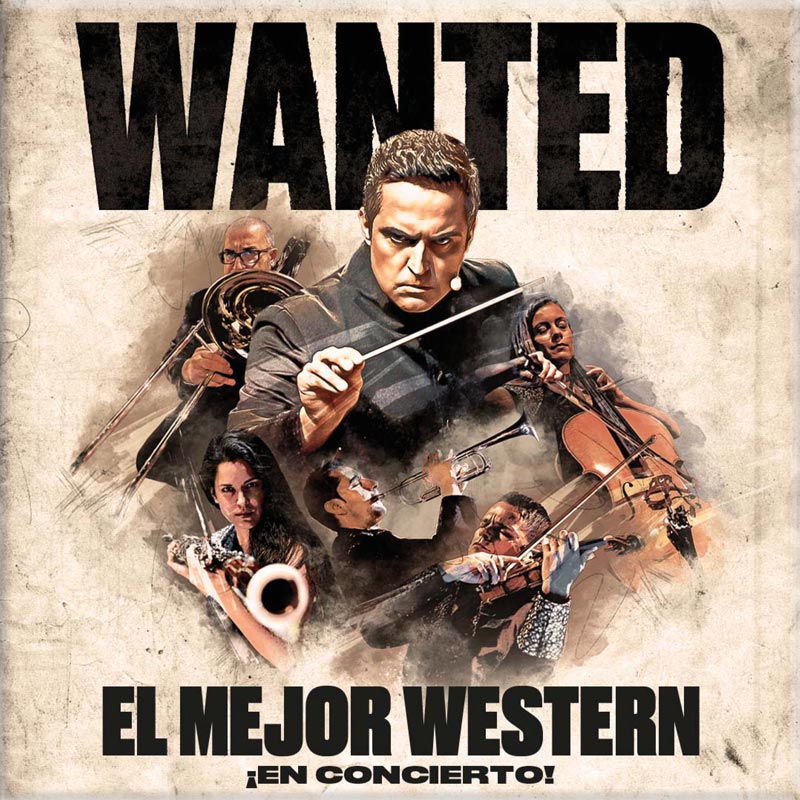
Film Symphony Orchestra – WANTED – Valencia 2026 [SPECIAL ARTICLE]
On Sunday, May 24, the Film Symphony Orchestra’s show WANTED, dedicated to Western music, came to Valencia, Spain. Our friend and colleague Frederic Torres attended the concert and has written a detailed special article, exclusively for SoundTrackFest.
![Film Symphony Orchestra - WANTED - Valencia 2026 [SPECIAL ARTICLE]](http://soundtrackfest.com/wp-content/uploads/2026/06/FSOWanted-Valencia2026-01.jpg "Film Symphony Orchestra - WANTED - Valencia 2026 [SPECIAL ARTICLE]")
WANTED Concert: THE BEST WESTERN. Film Symphony Orchestra (FSO), conducted by Constantino Martínez-Orts. Valencia. May 24, 2026
In the midst of its annual tour (2025–26 season), dedicated to animated film music and titled “Toon Story”—which was reviewed during its stop at the Palacio de Congresos in the capital of the Turia in November 2025 (read the special article)—the Film Symphony Orchestra has still found time to add another themed concert, just the day after performing the aforementioned animated program for the third time in the city—the last two performances having already taken place at the Palau de la Música.
Thus, the Valencian venue was completely taken over by the FSO that weekend (May 23 and 24), with the novelty of finally presenting this specific concert dedicated entirely to Westerns—a program previously performed in major cities such as Madrid and Barcelona. In fact, the FSO’s director and CEO, Constantino Martínez-Orts, in addition to planning the annual tours and the repertoire for each season’s nearly eighty concerts, occasionally presents exclusive events like this one, as well as others such as Dracul, dedicated to horror and monster music, presented in Madrid to celebrate Halloween night, and which this year will also debut in Valencia on November 1, All Saints’ Day, as well as the concert dedicated to the late James Horner, which will be performed again on June 26, exclusively in Madrid.
The “Wanted” program (virtual, since the printed program has long since ceased publication) consists of exclusive titles from the genre, selected and curated by Martínez-Orts himself, and bears his personal stamp as he strives to balance classic composers with more innovative ones (mostly from the 1980s and 1990s, the decades most emotionally linked to the conductor’s youth and his budding passion for and interest in film music), along with music from the so-called spaghetti western genre, popularized by Morricone, which is a must at a concert of this nature.
![Film Symphony Orchestra - WANTED - Valencia 2026 [SPECIAL ARTICLE]](http://soundtrackfest.com/wp-content/uploads/2026/06/FSOWanted-Valencia2026-03.jpg "Film Symphony Orchestra - WANTED - Valencia 2026 [SPECIAL ARTICLE]")
And I stand by that editorial choice, because, setting aside individual personal preferences, and if one sets aside the purist concerns that such a selection may entail, the various eras of the genre are indeed covered, despite the omission of some key figures such as Max Steiner, for example, amongst the most classic, and many others such as Alex North, Maurice Jarre and Jerry Fielding, not to mention some more contemporary and prolific figures in the genre, such as Jerry Goldsmith. That said, and recognising that you can’t please everyone, the FSO took to the stage with each of its members dressed as cowboys, Native Americans (some even chanting traditional songs), and so on, accompanied by stage props including straw bullets and a few carriages to help transport the audience into the scene. Martínez-Orts himself swapped the ‘Matrix-style cassock’ in which he usually appears before the public for an outfit more in keeping with the genre, consisting of a waistcoat, a hat (which he had to remove to be able to conduct properly), and a sort of raincoat as a distinctive garment. All this took place in the midst of a ‘Valencian-style’ heatwave, which is all the more commendable.
With the context now established, the programme began with the ‘Main Titles’ from one of the most classic and renowned films in the history of the Western, composed by the great Alfred Newman for How the West Was Won (1963), the epic film presented using the spectacular Cinerama system (which combined no fewer than three cinema screens), and directed by Henry Hathaway, John Ford and George Marshall, whose catchy overture has become part of what is universally recognised as Western music, and which remains widely recognised by the general public to this day. The performance was up to the task, although the ostinato—supported by the snare drum rolls, which in the film’s original recording are heard with great, vibrant intensity—perhaps lacked a certain energy.
![Film Symphony Orchestra - WANTED - Valencia 2026 [SPECIAL ARTICLE]](http://soundtrackfest.com/wp-content/uploads/2026/06/FSOWanted-Valencia2026-05.jpg "Film Symphony Orchestra - WANTED - Valencia 2026 [SPECIAL ARTICLE]")
It was not the only ‘classic’ on the programme (the quotation marks are used because, in reality, the former can already be considered a contemporary film, having been released at the very start of the 1960s) to be presented by the FSO, for whilst Newman opened the first part, Elmer Bernstein was the composer chosen to bring it to a close with a ‘Suite’ from his no less popular and acclaimed The Magnificent Seven (1960), which Martínez-Orts, in his ever-informative explanations prior to each performance, remarked had come and gone without much fanfare, when in fact it was nominated for an Oscar at the time. This was probably the year that the most seasoned fans consider to be the finest in the entire history of the Oscars (as the other nominees were Alex North for Spartacus, André Previn for The Fire and the Word, Dimitri Tiomkin for The Alamo – whose suite was also performed by the FSO during the concert, as will be discussed later – and Ernest Gold for Exodus, which ultimately won the coveted statuette).
In any case, this music—like others performed during the concert—draws heavily on styles considered quintessentially American, shaped by the work of composers such as Virgil Thompson and, above all, Aaron Copland, thanks to such iconic and beloved works as Appalachian Spring, Rodeo, and his ballet dedicated to Billy the Kid. Bernstein’s piece also became very popular decades later, as Martínez-Orts recalled, serving as the theme music for a well-known cigarette brand when this harmful product was at the height of its advertising boom between the 1970s and 1980s; the music reinforced the idea that the brand smoked by real cowboys was the best, as it was considered the quintessential example of Western music.
In between, the audience had the opportunity to hear a few more classics, such as the song “Do Not Forsake Me (No Me Abandones)” from High Noon (1952), the legendary film starring Gary Cooper and directed by Fred Zinnemann, with music by another giant of the genre, Dimitri Tiomkin, who won Oscars for both Best Song (along with lyricist Ned Washington) and Best Original Score, performed with conviction by Toni Dublet. Dublet also performed the “Theme” titled “El Correo del Infierno” from the television series Rawhide (1959), one of the Russian-Ukrainian composer’s few works for television, which starred and introduced Clint Eastwood to American television audiences, before he became famous for Sergio Leone’s aforementioned spaghetti westerns, and which was performed midway through the second half. During the second half, another highly faithful suite from the musical masterpiece The Alamo (1960)—also mentioned earlier—was performed, in which the solo by Valencian trumpeter Rubén Zaragoza García shone with poise and fidelity as he tackled the famous “DeGüello,” which would later inspire Morricone’s popular solos for the well-known “Dollar Trilogy.”
![Film Symphony Orchestra - WANTED - Valencia 2026 [SPECIAL ARTICLE]](http://soundtrackfest.com/wp-content/uploads/2026/06/FSOWanted-Valencia2026-06.jpg "Film Symphony Orchestra - WANTED - Valencia 2026 [SPECIAL ARTICLE]")
Among these classics, it’s also worth highlighting the “Main Titles” from Horizons of Grandeur (1958) by Jerome Moross—one of those great films from classic Hollywood that should have won the Oscar at the time, but lost out to Tiomkin for a more meticulous yet less showy work: his score for the stilted adaptation of Ernest Hemingway’s The Old Man and the Sea. This is one of those injustices that fans of film music have often been up in arms about in recent times, but which have been happening since the beginning, as can be seen. The symbolism inherent in Moross’s music, and the evocation of the vast prairies through his score, is particularly evident, and it remains one of the most highly regarded scores representing the genre, although it is quite complex to perform given the liveliness of the strings with which the central overture opens, followed by simply stunning brass. Under the baton of Martínez-Orts, the FSO performed the two most characteristic themes of that overture with energy, although there was perhaps a slight lack of density in the strings. In any case, it was a vibrant start to the second half of the concert that once again had the boisterous audience glued to their seats, following the now-traditional raffle for a trip to Hollywood for two people—to be won by correctly identifying the ten titles the FSO performed, each in just over five seconds, in a quiz-style format, all related to the world of animation, the theme of their current tour.
As for more contemporary composers, the first half of the concert featured the Suite dedicated to Wyatt Earp, composed in 1994 by the great James Newton Howard and performed with poise and conviction by the FSO, immediately following “The John Dunbar Theme” by British composer John Barry, who won his fifth Academy Award for this solemn and elegant score for Dances with Wolves (1990)—the film that marked Kevin Costner’s definitive triumph on the big screen—in what amounted to a sort of diptych paying tribute to the actor.
Also featured were Tombstone (1993)—which also revolves around the legendary Earp (though played by Kurt Russell this time)—performed during the first half of the concert, and Silverado (1986), during the second half, near the end of the concert, both composed by the masterful yet underappreciated Bruce Broughton, which fulfilled the quota of that aforementioned ’80s and ’90s cinema that Martínez-Orts grew up with and that has had such a profound impact on him—and on an entire generation that developed a passion for film music through the great John Williams and the school of film composers that emerged under his influence.
In fact, the program included the immense (in terms of both quality and length) “Overture” from The Cowboys (1972), a film starring a twilight-era John Wayne that featured a magnificent score by a little-known John Williams (at the time of its release, he had not yet even composed the music for Jaws —1975— much less begun the Star Wars saga—1977—), in which the nonagenarian American artist delivered a symphonic display that reimagined Copland at his finest, with a performance by the FSO bordering on perfection, as this is music they have performed numerous times and know inside and out, as was clearly evident.![Film Symphony Orchestra - WANTED - Valencia 2026 [SPECIAL ARTICLE]](http://soundtrackfest.com/wp-content/uploads/2026/06/FSOWanted-Valencia2026-04.jpg "Film Symphony Orchestra - WANTED - Valencia 2026 [SPECIAL ARTICLE]")
The rapport among the performers—through glances, chants, rhythmic movements, and the occasional bit of dancing—grew stronger during the performances dedicated to Morricone. In addition, a variety of musical elements were incorporated, because, as the director explained, the lack of a budget in those early spaghetti westerns sharpened the composer’s ingenuity; in the absence of large symphony orchestras, he turned to unusual resources, such as voices (those of the musicians themselves), harmonica (Rubén Traver), guitar (Alex Sánchez), electric bass (Rafa Martínez Rodríguez), mouth harp (also Traver), and even whistlers (Bauti Carmena)—elements that might at first seem anachronistic but which, nevertheless, propelled the Roman composer to immense popularity.
The first piece to take the stage, during the first half of the concert, was the impressive crescendo of “L’ultima Diligenza di Red Rock (The Last Stagecoach of Red Rock),” from The Hateful Eight (2015), the Quentin Tarantino film for which Ennio Morricone ultimately won the Oscar in the competitive category, just a few years before his death (despite already having received an honorary Oscar for his entire career, as Martínez-Orts also noted). The FSO performed this harrowing crescendo in all its glory, thereby bringing back the darker, lesser-known side of Morricone—even in the face of the recognition that the golden statuette represented.
But it was during Morricone’s second composition that the audience—whose average age was higher than usual for FSO concerts (remember that, aside from Tarantino’s film, there were no other films from this new century or millennium)—recognized themselves in the Roman composer’s music. The “Main Titles” from For a Few Dollars More (1965), performed between Broughton’s and Bernstein’s first suites—both featured in the first half of the program—made the Italian composer’s “experimental” musical daring even more evident, followed by the sequel to A Fistful of Dollars (1964), whose “Suite” was performed in the second half of the concert, in reverse order; and due to the slight discrepancy in the Spanish titles, few members of the audience realized that it is actually a directly related diptych (since in the original, the latter is titled “Per un Pugno di Dollari,” and the former, “Per Qualche Dollare in Più”). The truth is that here, a certain segment of the audience had a blast, likely reminiscing about childhood afternoons at small-town or neighborhood movie theaters with double features, where spaghetti westerns entertained the kids of that era.
In Once Upon a time in the West (1968), the voice of Anaís Sancruz was incorporated; positioned above the orchestra, at the level of the Palau’s organ, she sought to emulate the great Edda del’Orso from the original, and, microphone in hand, managed to make her voice resonate widely throughout the venue, almost drowning out the orchestral tutti, in a composition with operatic characteristics (as Martínez-Orts rightly pointed out), in which Rubén Traver’s harmonica also played a fundamental role at the beginning of the musical segment. Referring to the film’s title and mentioning the films belonging to the “Dollar Trilogy” not only in Spanish but also in English (when the originals are obviously Italian) might have confused the occasional inattentive listener or led to some misunderstanding, but since the program is virtual and the link to it becomes inaccessible after a few days—unless one has been cautious enough to download the corresponding PDF—it’s not something the average attendee of FSO performances can verify.
![Film Symphony Orchestra - WANTED - Valencia 2026 [SPECIAL ARTICLE]](http://soundtrackfest.com/wp-content/uploads/2026/06/FSOWanted-Valencia2026-10.jpg "Film Symphony Orchestra - WANTED - Valencia 2026 [SPECIAL ARTICLE]")
The final climax came with the “Suite” from The Good, the Bad, and the Ugly (1966), featuring that wild “Ecstasy of Gold” sequence with which Leone closed his film—and which Martínez-Orts managed to convey to the audience. A Morricone-esque frenzy that perfectly captured the essence of that contrast between the “American-style” elegance of the scores composed by the classics—Newman, Tiomkin, Moross, and Bernstein—as well as the more restrained Williams, Broughton, and Howard, and Morricone’s “unique” inventions, which even today continue to amaze with their audacity and inventiveness, although some of us still find it hard to associate that music with the great American prairies.
As an encore, the talented Martínez-Orts performed the theme song from the popular television series Bonanza (1959–73), which was a hit on screens around the world (in these parts, starting in the mid-1960s), composed by Ray Evans and Jay Livingston, minor composers, but with highly representative hits such as this one, to soften and lighten the tension of the finale of the preceding Morricone suite, rounding out the performance with a rendition of “Cantina Band” from Star Wars (1977), the FSO’s customary concert finale in which the bows of the violins, violas, cellos, and double basses “magically” transform into lightsabers, and the various sections bid farewell by dancing to the festive, jazzy chords of John Williams’ well-known theme. A fitting finale, given the concert’s theme—for as much science fiction and fantasy as Lucas infused into his galactic project, it was, in reality, a reimagining of the most classic Western from a futuristic and visionary perspective.
![Film Symphony Orchestra - WANTED - Valencia 2026 [SPECIAL ARTICLE]](http://soundtrackfest.com/wp-content/uploads/2026/06/FSOWanted-Valencia2026-11.jpg "Film Symphony Orchestra - WANTED - Valencia 2026 [SPECIAL ARTICLE]")
On the way out, with the audience exhausted but enthusiastic, there were still those who took the customary photo at the photocall alongside the mixed team dressed in ad hoc costumes (which included a “hanging tree,” complete with a noose), accompanying Martínez-Orts himself, who, before closing the concert, had time to announce the first-ever performance of Dracul in Valencia, as well as the October premiere—also in the capital of the Turia—of the FSO’s new tour titled “Odyssey” (read more), which will feature epic cinema, with titles such as those from the Avatar saga, among many others. We’ll be at both concerts and will let you know all about them—provided no sheriff or bounty hunter gets in the way.
![Film Symphony Orchestra - WANTED - Valencia 2026 [SPECIAL ARTICLE]](http://soundtrackfest.com/wp-content/uploads/2026/06/FSOWanted-Valencia2026-12.jpg "Film Symphony Orchestra - WANTED - Valencia 2026 [SPECIAL ARTICLE]")
Article and pictures by Frederic Torres


