
Alexandre Desplat: From Paris to Hollywood – Luxembourg 2026 [SPECIAL ARTICLE]
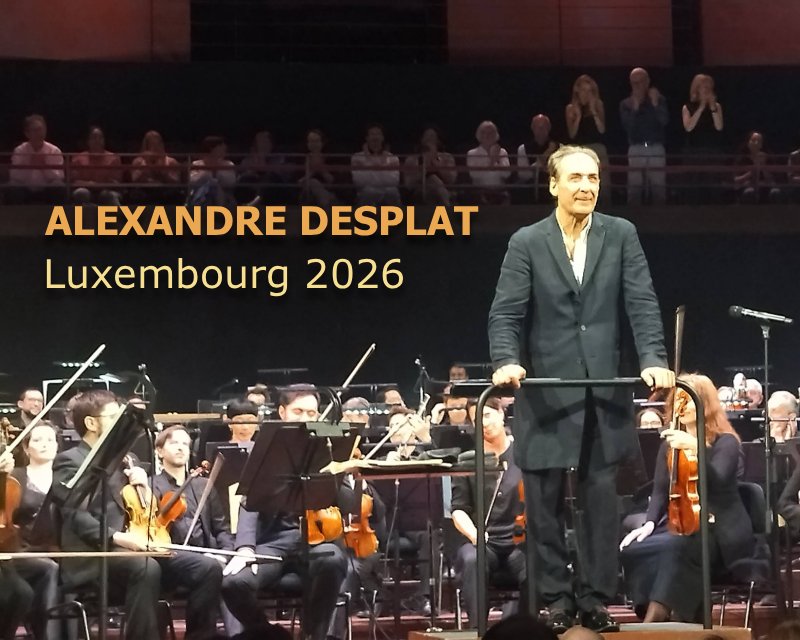
On 11 June, composer Alexandre Desplat took to the podium to conduct the Orchestre Philharmonique du Luxembourg in the concert ‘Alexandre Desplat: From Paris to Hollywood‘.
Our friend and colleague Frederic Torres attended the concert and has written a detailed special article, exclusively for SoundTrackFest.
![Alexandre Desplat: From Paris to Hollywood - Luxembourg 2026 [SPECIAL ARTICLE]](http://soundtrackfest.com/wp-content/uploads/2026/08/AlexandreDesplatLuxembourg-June2026-Banner-1000x400-1.jpg "Alexandre Desplat: From Paris to Hollywood - Luxembourg 2026 [SPECIAL ARTICLE]")
Concert: From Paris to Hollywood. Alexandre Desplat. 11 June 2026. Luxembourg.
At the end of January 2025, the French composer, two-time Oscar-winning, Alexandre Desplat presented and conducted the Orchestre de Paris in the programme titled De Paris à Hollywood (in the original) (read more), devised by his wife and artistic partner, violinist, arranger and artistic director Solrey (Dominique Lemonnier). This was followed, in September of that same year, by the release from Warner Classics of a superb double-CD edition featuring a recording of the programme with the same orchestral line-up, as well as an exclusive cinema premiere of the concert recorded in Paris, which was also broadcast shortly afterwards on the ARTE television network (read more).
Likewise, in April of last year, under the title The Film Music of Alexandre Desplat, Solrey herself, given her husband’s commitments in Hollywood, conducted a very similar selection to the one presented in Paris (with some slight variations) in Hong Kong (read more). Then, in March 2026, the original programme was presented in Rotterdam (a concert titled Desplat Conducts his Film Music – read more).
Having been unable to attend any of these earlier concerts, I was not about to miss the opportunity to attend this new staging of the concert, Alexandre Desplat: From Paris to Hollywood (read more) (the official English title used on the printed programme, though the text itself was in French and German, the customary languages of this small central European country, based directly on the liner notes written by François-Gildas Tual for the aforementioned double CD – although the German text was not a simple translation and was, curiously, credited to Patrick Mertens).
Staged in the modern Philharmonie Luxembourg building (opened in 2005 and fitted with 823 white columns intended to evoke the movement of sound waves and the effect of sound, according to the concept of its architect, Christian de Portzamparc), the concert took place on Thursday, 11 June, with the Orchestre Philharmonique du Luxembourg under the baton of the composer himself (the following month, on Thursday 9 July, the French artist repeated the programme with the Orchestra dell’Accademia Nazionale di Santa Cecilia at the Basilica of Maxentius in Rome, under the title The Cinematic World of Alexandre Desplat – read more).
![Alexandre Desplat: From Paris to Hollywood - Luxembourg 2026 [SPECIAL ARTICLE]](http://soundtrackfest.com/wp-content/uploads/2026/08/AlexandreDesplatLuxembourg-June2026-01.jpg "Alexandre Desplat: From Paris to Hollywood - Luxembourg 2026 [SPECIAL ARTICLE]")
The programme was as follows:
Beginning promptly at 19:30h with the hall packed to capacity, the concert offered a selection of Desplat’s work for the Hollywood film industry, opening with the composer himself conducting (always without a baton) a magnificent suite from his splendid score for Terrence Malick’s film, The Tree of Life (2011) – a work that the notoriously idiosyncratic director ultimately diluted by incorporating an enormous amount of pre-existing music into the final cut (following his post-production modus operandi, dreaded above all by composers), to the point where Desplat’s work was ruled ineligible for Academy Award consideration. Ethereal and dramatic in character, its idiosyncrasy made this suite the perfect opener for the concert’s first half, marked by a dramatic, melancholic tone – reinforced by the second suite, also lasting close to ten minutes, taken from The Curious Case of Benjamin Button (2008), David Fincher’s film based on a short story by F. Scott Fitzgerald, starring Brad Pitt and Cate Blanchett, for which Desplat received an Academy Award nomination.
A subtle and deeply felt performance was reaffirmed by the following “Suite Royale“, made up of three films connected to the British Crown: The Queen (2006), The King’s Speech (2010), and The Lost King (2022) – the first and last directed by Britain’s Stephen Frears, with whom Desplat has maintained a steady collaboration spanning more than a decade, and the remaining one by Tom Hooper, who also earned the composer a further nomination (as did the first of the two Frears films). Particularly striking was the central theme of the film starring Colin Firth, an exquisite waltz-form piece strongly reminiscent of the one Vladimir Cosma composed for the far less well-known Les Palmes de M. Schutz (1997), which might have won the coveted statuette had the decision not been made to use the “Allegretto” from Beethoven’s Seventh Symphony for the film’s climactic scene – the one in which George VI managed to deliver his 1939 radio broadcast without a single stammer, the principal source of the monarch’s torment and complex (and of the film’s plot).
![Alexandre Desplat: From Paris to Hollywood - Luxembourg 2026 [SPECIAL ARTICLE]](http://soundtrackfest.com/wp-content/uploads/2026/08/AlexandreDesplatLuxembourg-June2026-04.jpg "Alexandre Desplat: From Paris to Hollywood - Luxembourg 2026 [SPECIAL ARTICLE]")
This elegant suite was followed by another highly original one, this time dedicated to filmmaker Wes Anderson, with whom Desplat has also maintained a long-standing collaboration since they first worked together on Fantastic Mr. Fox (2009), which likewise earned the composer a nomination, in addition to the film’s Best Animated Feature win. This was, fittingly, the title that opened the musical trilogy, with its martial yet endearing march, followed by the central theme from The Grand Budapest Hotel (2014), catchy in character and notable for its use of the mandolin, which would go on to earn Desplat his first Academy Award. The suite concluded with the most recent but least well-known of the three, The French Dispatch (of the Liberty, Kansas Evening Sun) (2021), forming a highly distinctive and personal musical arc that has left an indelible mark on the cinema of this singular and often controversial filmmaker.
To close the first half, the composer and orchestra tackled an extensive suite dedicated to The Shape of Water (2017), Guillermo del Toro’s poetic and imaginative film (another regular collaborator of Desplat’s, with whom he has since earned a further nomination for his impeccable work on the Mexican director’s 2025 version of Frankenstein). The piece shone brightly in its own right, further enhanced by the skilful use of the accordion – employed as a dramatic solo instrument rather than a merely contextual one – and by the soft blue lighting that Solrey’s delicate artistic direction lent the stage. A thoroughly delightful piece of music that at times seemed to conjure up a resurrected Debussy or Ravel at the podium, with a deeply inspired and melancholic score that also paid homage to the typical 1950s monster-movie music of composers such as Hans J. Salter and Ronald Stein, as well as the early work of Henry Mancini and Elmer Bernstein. A pure delight that earned the composer his well-deserved second Academy Award at the time, and which shone all the more brightly in this live performance.
![Alexandre Desplat: From Paris to Hollywood - Luxembourg 2026 [SPECIAL ARTICLE]](http://soundtrackfest.com/wp-content/uploads/2026/08/AlexandreDesplatLuxembourg-June2026-02.jpg "Alexandre Desplat: From Paris to Hollywood - Luxembourg 2026 [SPECIAL ARTICLE]")
The second half of the concert appeared to continue along the same lines, with a performance of the lyrical central theme from Little Women (2019), Greta Gerwig’s free adaptation of Louisa May Alcott’s classic, updated for modern times at the height of the “Me Too” feminist movement, which earned six Academy Award nominations, including a further one for Desplat. But this was merely a mirage, because the orchestra then set to work in earnest on a brilliant and powerful suite dedicated to the two films that make up Harry Potter and the Deathly Hallows (2010–2011), the conclusion of the enormously popular boy wizard’s saga. This diptych-style finale produced a vibrant score from Desplat, who faced a daunting challenge given the musical popularity achieved by John Williams in the saga’s first three instalments. The Frenchman did not shy away and delivered a tense, epic score in the tradition of the American symphonic school – of which Williams is one of its foremost exponents – without resorting to the well-known themes Williams had composed for the saga. A considerable challenge that Desplat managed to overcome, despite the lack of recognition he received on this occasion from the ever-inscrutable Academy.
That was not the case with The Imitation Game (2014), which centres on the efforts of a team led by English mathematician Alan Turing, played by Benedict Cumberbatch (who received a Best Actor nomination), to crack the German Enigma code used by the Nazis to encrypt their messages – its tense score was indeed recognised by the Academy that year. The nearly fifteen-minute suite (the longest of the concert) bears witness to the importance placed on this work, after which the programme officially drew to a close with the powerful overture the French composer dedicated to Godzilla (2014), drawing on the distinctive style used by Japanese composer Akira Ifukube for the original 1954 film. A tribute that set the auditorium trembling, given the magnificence of Desplat’s composition, immense in both strings and brass.
![Alexandre Desplat: From Paris to Hollywood - Luxembourg 2026 [SPECIAL ARTICLE]](http://soundtrackfest.com/wp-content/uploads/2026/08/AlexandreDesplatLuxembourg-June2026-06.jpg "Alexandre Desplat: From Paris to Hollywood - Luxembourg 2026 [SPECIAL ARTICLE]")
The applause with which the audience greeted the compositions produced three encores, the first of which was a suite dedicated to Girl with a Pearl Earring (2003), one of Desplat’s most sensitive compositions and also one of his earliest international collaborations, granting him a level of visibility previously unimaginable – and one that departed somewhat from the established script, since this suite is not included on the aforementioned double CD. This was followed by the vibrant central theme from The Ghost Writer (2010), Roman Polanski’s film starring Ewan McGregor and Pierce Brosnan, which earned Desplat the César Award for Best Music. The concert then reached its definitive conclusion with the strikingly colourful waltz from Birth (2004), the film by Oscar-winning director Jonathan Glazer starring Nicole Kidman. This piece provided a spectacular yet emotionally charged finale (fittingly, being a waltz) to a concert throughout which the composer clearly felt the audience’s warmth, to the point of taking a selfie from the podium with the crowd applauding wildly behind him, as a treasured keepsake. A genuine communion between music and cinema that the changeable, springlike Luxembourg weather did nothing to dampen on the way out of the venue – it was raining lightly but persistently – leaving a thoroughly satisfying taste for all those in attendance.
Article and photos by Frederic Torres
![Alexandre Desplat: From Paris to Hollywood - Luxembourg 2026 [SPECIAL ARTICLE]](http://soundtrackfest.com/wp-content/uploads/2026/08/AlexandreDesplatLuxembourg-June2026-07.jpg "Alexandre Desplat: From Paris to Hollywood - Luxembourg 2026 [SPECIAL ARTICLE]")


